For exporters shipping auto parts to European markets such as Germany, Poland, and France, several questions come up frequently: How long does it take to ship auto parts to Europe by the China-Europe Railway Express? Is rail freight expensive? Should I choose FCL or LCL? In practice, these questions cannot be answered by looking at a single figure. The right solution depends on the origin, destination, product type, weight, volume, delivery schedule, and scope of delivery.
1. How Long Does It Take to Ship Auto Parts by China-Europe Railway Express?
There is no single fixed transit time for the China-Europe Railway Express. Transit times vary depending on the origin, destination, and specific train service. For example, according to publicly available railway information in 2026, some scheduled services from Xi'an to Duisburg can have a fastest transit time of around 12 days. Source: publicly available railway information. Actual transit times are subject to the specific train service and operating conditions.
It is important to note that the 12-day figure mainly refers to station-to-station rail transit and does not necessarily mean door-to-door delivery in 12 days. For a shipment from a factory in China to a customer's warehouse in Europe, additional time may be required for domestic pickup, cargo consolidation, customs declaration, customs clearance, and final-mile delivery. If the auto parts have a specific delivery deadline, it is recommended to plan based on the complete door-to-door transit cycle.
2. How Should You Choose Between Rail, Sea, and Air Freight?
A simple comparison is:
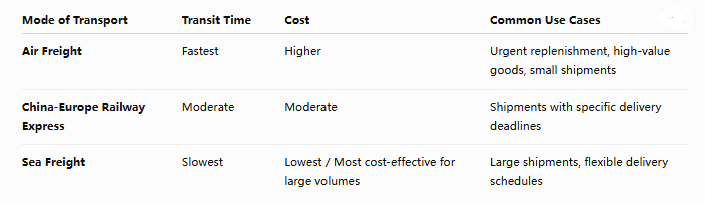
However, it is not advisable to simply assume that rail freight is always a certain amount cheaper than air freight, or that sea freight always takes a fixed number of days. Actual costs and transit times are affected by multiple factors, including the origin, destination, weight, volume, container type, cargo characteristics, and delivery requirements.
3. Should You Choose FCL or LCL for Auto Parts?
For larger shipment volumes, FCL can be considered. If the auto parts are relatively heavy, the shipment volume is stable, a dedicated container is required, or the cargo has specific loading requirements, rail FCL may be worth evaluating.
For smaller shipment volumes, LCL can be considered. For example, if you have 3 CBM, 5 CBM, or 8 CBM of auto parts and the cargo does not fill a full container, rail LCL may be a suitable option to compare.
However, the choice between FCL and LCL should not be based on CBM alone. Weight, packaging, cargo characteristics, destination, and delivery schedule should also be considered together.
4. What Should You Pay Attention to When Exporting Auto Parts to Europe?
1. Make sure the product description and customs declaration information are accurate. Do not simply declare all products as "auto parts." Products such as brake pads, filters, wheel hubs, and lighting equipment should be classified based on the actual product, including the product description, HS code, material, intended use, quantity, and other relevant information. The key principle is to ensure consistency between the actual cargo, shipping documents, and customs declaration information.
2. Check requirements for wooden packaging in advance. If wooden crates, wooden pallets, or wooden frames are used, confirm the relevant requirements of the destination country in advance and pay attention to ISPM 15 and IPPC requirements.
3. Review shipments involving transit routes through Russia and other countries in advance. It is not sufficient to assess the shipment simply based on the general category of "auto parts." The HS code, product characteristics, transportation route, and latest applicable regulatory requirements should all be reviewed to determine whether the shipment is suitable for the selected route.
5. Why Can Quotes Differ So Much for Shipments from China to Germany?
In many cases, the reason is that the scope of the quotation is different.
For example, Quote A may cover station-to-station transportation from a Chinese origin station to a destination station in Germany. Quote B may cover transportation from a factory in China to the customer's warehouse in Germany and may already include services such as pickup, customs declaration, rail transportation, customs clearance, and final-mile delivery.
Therefore, when requesting a quotation, it is better not to ask only, "How much does it cost to ship auto parts to Germany?" Instead, provide the product description, origin, destination, weight, volume, required delivery date, and whether door-to-door service is required.
This information makes it easier to determine whether rail or sea freight is more suitable, whether FCL or LCL should be considered, which route should be used, and whether the quotation should be based on station-to-station or door-to-door delivery.
6. Conclusion
There is no single fixed transit time applicable to all auto parts shipments by China-Europe Railway Express. For example, publicly available railway information shows that some scheduled services from Xi'an to Duisburg can have a fastest transit time of around 12 days. Source: publicly available railway information. Actual transit times are subject to the specific train service and operating conditions.
However, for shipments from a factory in China to a customer's warehouse in Europe, additional time must be considered for pickup, customs declaration, customs clearance, and final-mile delivery.
For exporters of auto parts, instead of simply asking, "Can the China-Europe Railway Express deliver in 12 days?", it is more useful to provide the logistics provider with the product type, origin, destination, shipment weight, volume, and required delivery date. Based on these details, the appropriate transportation mode—rail, sea, FCL, or LCL—can then be evaluated.
The key is not to decide how to ship first, but to determine which transportation solution is most suitable for the shipment.