On October 12, a China-Europe freight train loaded with auto parts and electronic products departed from Alashankou Port for Malaszewicze, Poland. With this departure, the number of China-Europe and China-Central Asia freight trains supervised by Alashankou Customs in 2026 exceeded 7,000, reaching the milestone 45 days earlier than last year. The total number of trains passing through the port ranks first in the country.
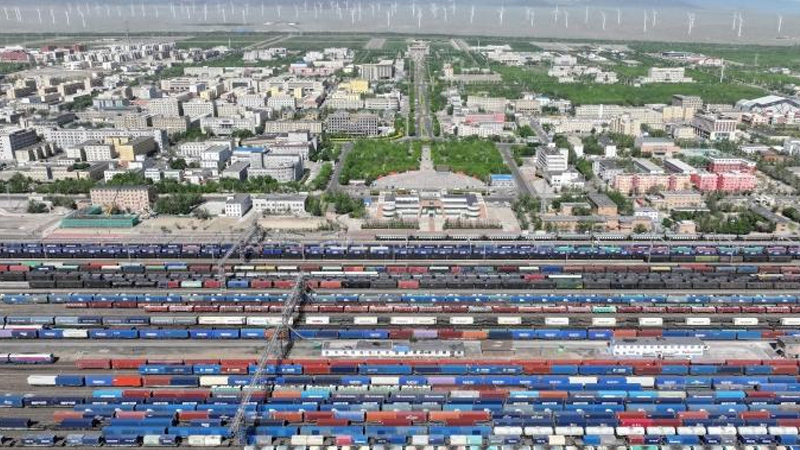
On September 2, operations at the marshalling yard of Alashankou Railway Station were in full swing, with inbound and outbound China-Europe freight trains and ordinary freight trains being marshalled and assembled in an orderly manner. Photo by Song Yulong
In previous years, the annual total of 7,000 trains was usually not reached until late November. This year, the port achieved the milestone in less than 11 months, driven by efficient customs supervision, coordinated multi-party operations, and strong market demand. The growth reflects not only an increase in transport capacity, but also a comprehensive improvement in the port’s customs clearance and governance efficiency.
As a freight train departed from the port, Zou Qingqing, a first-level administrative law enforcement officer with the Railway Supervision Division of Alashankou Customs, had already received the manifest information for the next train on her computer, realizing the model of “goods in transit, data arriving first.” “In the past, trains waited for personnel and containers waited for documents. Now, documents are ready before trains arrive, and cargo is ready for loading,” said Zou. Previously, customs and railway systems operated independently. Information such as manifests, cargo arrival status, customs release, and loading was transmitted manually through paper documents, which often led to information delays and data entry errors. Enterprises had to file declarations at both their local customs office and the port, and undergo verification twice.
This change stems from the “Smart Railway Port + Local Fast Customs Clearance” reform. Cargo manifests are transmitted in advance before goods arrive, allowing customs to review documents and assess risks ahead of time. The reform has eliminated procedures such as transit declarations, secondary declarations, and port verification. Enterprises can now complete a single declaration at their local customs office, with clearance applied throughout the entire journey. Customs and railway data are synchronized in real time across the full supply chain and verified through intelligent systems, forming a one-stop closed-loop process. Low-risk cargo is released quickly, while high-risk cargo is subject to targeted controls, balancing efficiency with regulatory security.
The benefits of customs clearance reform have reached foreign trade enterprises. Yang Yiyong, business manager of Alashankou Bobao International Freight Forwarding Co., Ltd., said that procedures can now be completed online in a single step, reducing customs clearance time from two or three days to as little as 16 hours and cutting corporate operating costs by 30 percent. The overall customs clearance time for imported goods has been reduced by more than 70 percent, container turnover has accelerated, and logistics, financial and labor costs have declined. A more stable clearance cycle has strengthened enterprises’ ability to fulfill orders and helped them expand cross-border business across Asia and Europe.
According to Zou, the series of reforms has reshaped the port’s customs clearance system. Alashankou Customs has advanced multiple reforms in parallel, increasing the inspection efficiency of individual trains by 70 percent. It has also pioneered a “port + unloading site” joint supervision model in Xinjiang, cutting overall customs clearance time in half. With intelligent equipment, inspections have shifted to non-intrusive supervision, and the shortest on-site inspection time for a single train has been reduced to just 10 minutes.
At present, Alashankou Port operates 130 China-Europe and China-Central Asia freight train routes, reaching 21 countries including Germany and Poland, and carrying more than 200 types of cargo. These services help strengthen an efficient and smooth Asia-Europe trade and logistics corridor.